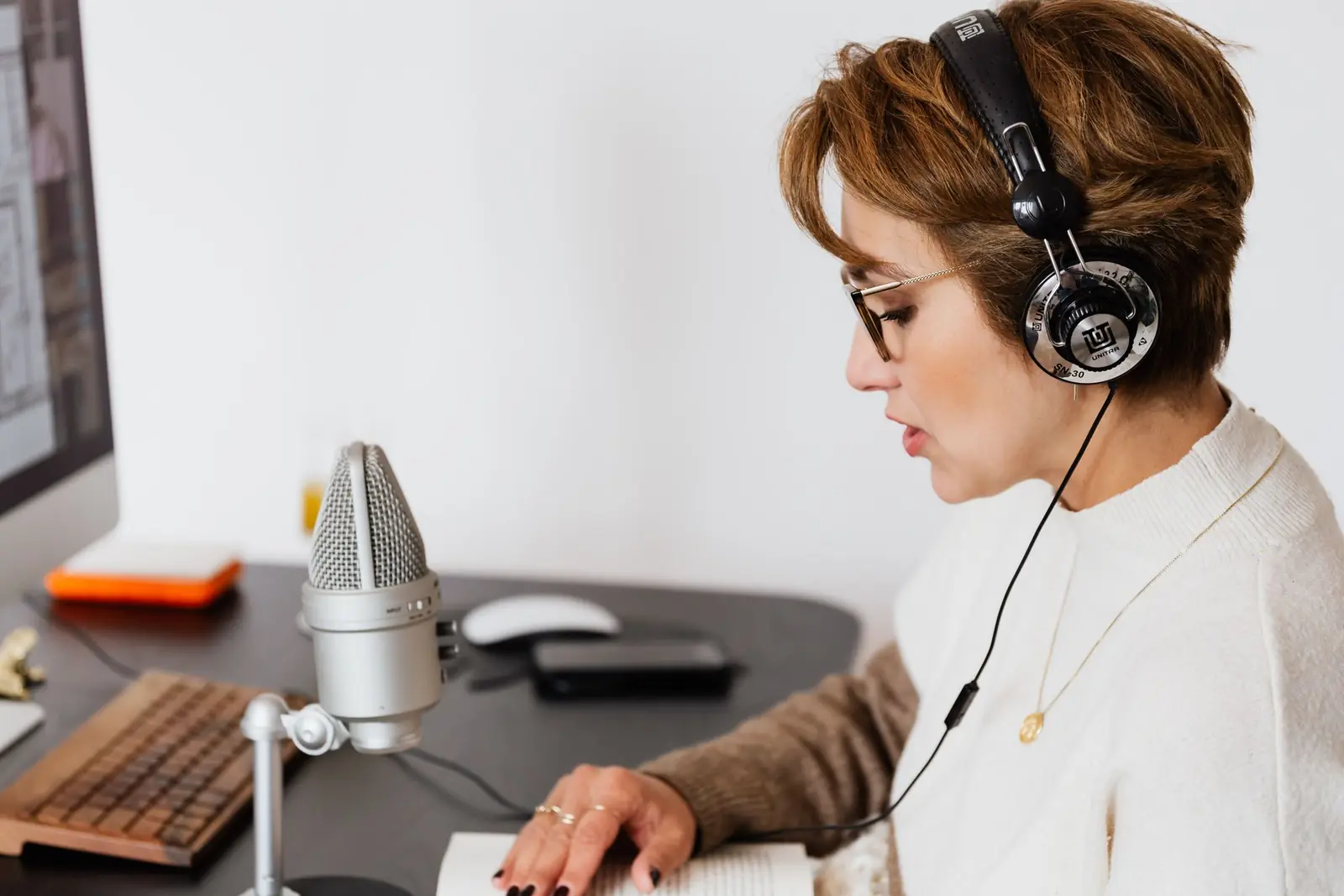
Many home studio guides online are written for music producers. This one is for a home in India, with tiled floors, ceiling fans, horns outside and the odd power cut. Pick your goal, fix the room, then buy in the right order.
Updated November 2026 · Prices checked 2 November 2026
Stock photo
Quick answer. Start with what you record, not with gear. For video calls, one soft light and a better webcam is enough, and a ready light-and-webcam kit starts at ₹7,985. A one-person podcast or talking-head YouTube kit costs about ₹25,000 to ₹26,000. A serious voice-over or music setup at home goes up to about ₹2 lakh. Whatever you spend, fix the echo and get a good mic close to your mouth before you buy a new camera.
We are Onewrk. We design and fit studios for companies, not homes. At home you need the right kit in the right room, set up well. Kit prices here come from OneProGear, our own gear store. Buy there, or use the lists to shop anywhere.
Models we name on this page. Links open OneProGear, our own gear store, where each one has its price and stock.
A studio setup at home for video calls and one for audiobooks need different things. Even a beginner home studio setup starts here.
You need a lit face and a clear voice. A webcam at eye level, one soft light, and a USB mic or a good headset.
Kit: video call and webinar, from ₹7,985.
One person at a desk: tutorials, explainers, reviews. Start with your phone, one key light and a dynamic mic.
Kit: YouTube talking head, from ₹26,075.
Sound is the whole job. One dynamic mic per person, closed headphones and a soft room. More in our podcast studio setup guide.
Kit: podcast studio, from ₹24,770 (one person, USB). Two people on XLR: ₹87,644.
Long takes show every echo, so the room matters most. A quiet corner with soft walls, a good mic and an audio interface.
Kit: voice-over and dubbing, from ₹24,774 up to ₹2,10,900.
Vocals or an instrument, recorded into music software (a DAW). You need a mic, a USB link or an audio interface, and closed headphones.
Kit: home recording studio, from ₹12,870 (a USB condenser kit) up to ₹2,03,890.
Your phone is the camera. Add a stand, a small light and a clip-on mic.
Kit: Reels creator, from ₹14,280.
Many Indian homes share the same few problems. Most fixes cost little.
Tiled floors and plain painted walls are hard and flat. Your voice bounces off them and reaches the mic a split second late. That is the hollow, bathroom sound on many home videos. To test, clap once where you will record. If you hear a ring after the clap, the room echoes.
The fix is soft things: a thick rug, heavy curtains, a sofa, a bed, cushions, a shelf of books. An open wardrobe full of clothes helps too. Fill the room first. Buy panels only if that is not enough.
If you need home studio acoustic treatment, use thick panels where your voice hits first: the wall in front of you and the side walls level with your head. Our soundproofing and acoustic treatment guide covers where panels go and what they cost. OneProGear has a short guide to treating a bedroom.
A ceiling fan makes a steady whoosh and pushes air across the mic, which can sound like wind. A split AC's indoor unit hums. Your ears tune these out. Your mic does not.
Cool the room first, then switch the fan and AC off for each take. Record in short blocks with cooling breaks. Noise removal software can lower a hum, but pushed hard it makes your voice sound thin.
You cannot keep a city out of a normal flat. Real soundproofing means heavy walls, sealed gaps and solid doors. That is building work. At home, work around the noise.
A power cut can kill a desktop computer mid-take, and the file with it. The Wi-Fi router dies too, so live calls drop. A small UPS keeps the computer, router and one light running long enough to stop and save. Pick a pure-sine-wave UPS for audio gear, as we do in company studios, and use a surge-protected strip.
Lenses can grow fungus in damp air, and condenser mics are fussier about damp than dynamic ones. Store both in a closed box with fresh silica gel, or in a dry cabinet. Gear carried from an AC room into humid air fogs up, so let it warm up first.
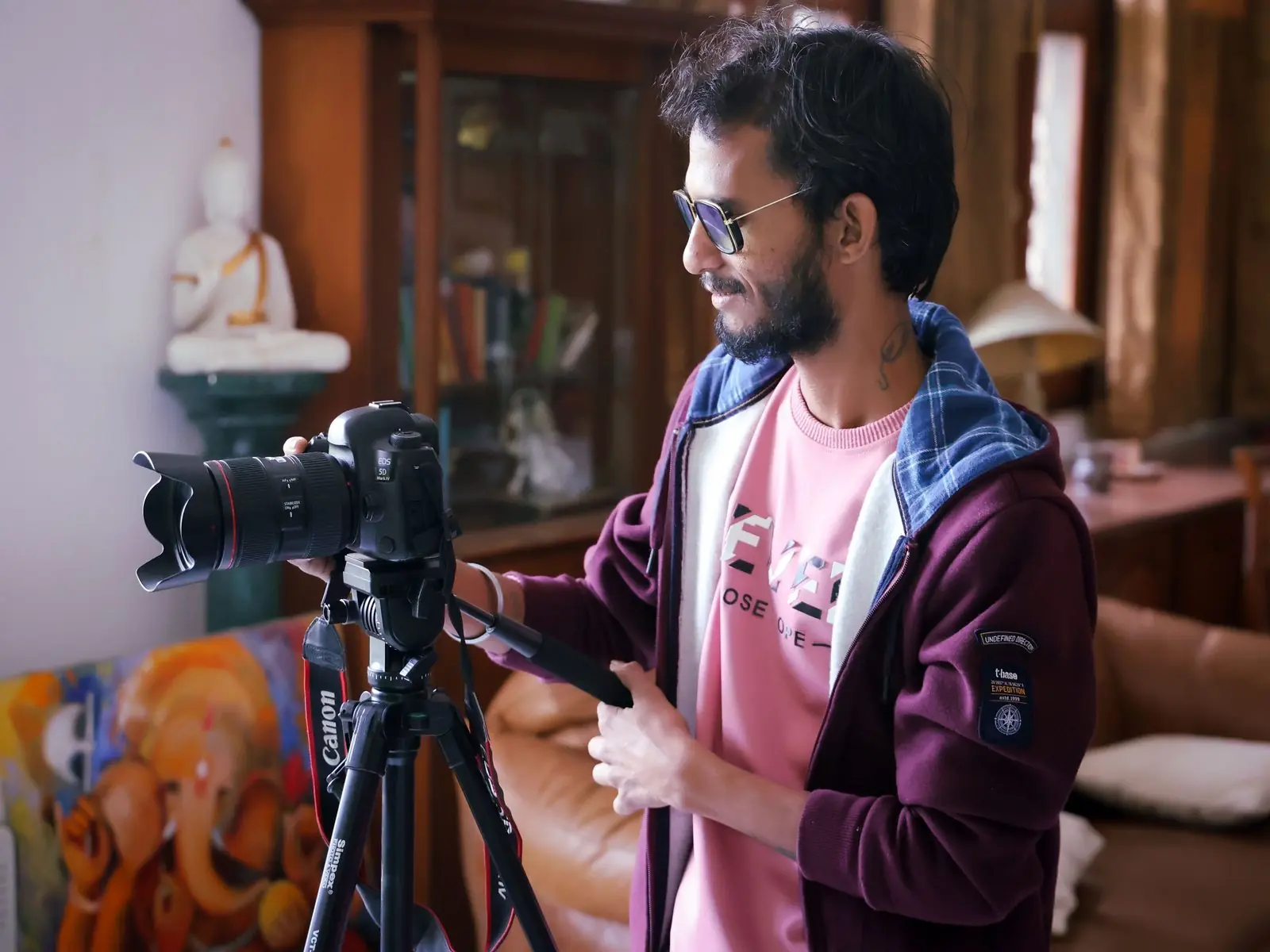
The biggest, emptiest room is usually the worst. A big hall with tiles and bare walls echoes the most.
A smaller room full of soft things usually wins. For many people that is the bedroom, with a bed, curtains and a wardrobe. It is often the quietest room too. A mini studio setup in one corner is enough for most people. Avoid rooms that sound like a bathroom: tiled walls, glass walls, the kitchen, or a big window onto the road.
Spend in this order. Each step does more, for less money, than the one after it.
A dynamic mic hears what is close to it and not much else. Close to your mouth, it hears you, and far less of the fan, the street and the echo.
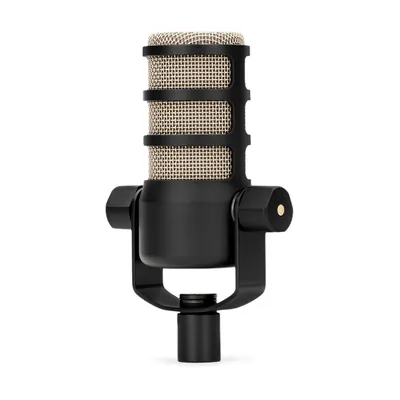
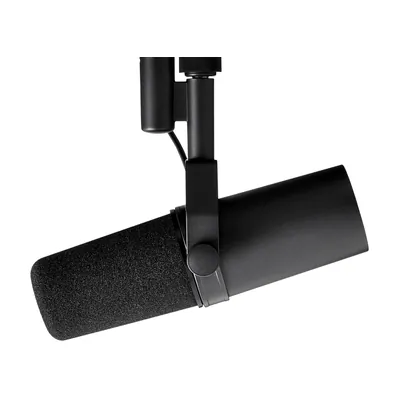
Recording alone? A USB mic plugs straight into a laptop. If a second person may join later, get an XLR mic and an audio interface or recorder. Some mics do both, like the RØDE PodMic USB and the Shure MV7+. The Shure SM7B is a classic, but it needs a strong preamp, so budget for one. Add closed headphones, so sound does not leak back into the mic, and a desk arm to keep the mic close without hiding your face.
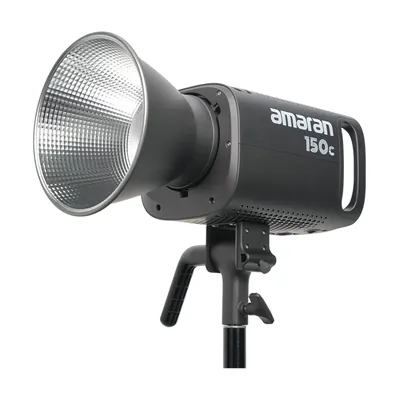
One soft light in the right place beats three in the wrong place. A small bi-colour LED light with a softbox is enough. Bi-colour lets you match daylight or warm bulbs. If the light has a fan, it needs a silent mode, or the mic will hear it.
Use your phone's back camera. On most phones it is the better one. Put it on a stand at eye level, and lock focus and exposure so the picture does not shift. For calls, a webcam like the Logitech C920S or Brio is a big step up from a laptop camera. Buy a proper camera only once your sound and light are sorted.
A UPS. A spare drive, so every recording has two copies. A tidy background. They cost little and save good takes.
These do little in a normal home. Skip them, or buy them last.
Face a window, or sit with it a little to one side. Never sit with it behind you, or the camera turns you into a dark shape. A thin white curtain makes the light softer. But daylight changes through the day, so for regular recording a light gives the same look every time.
Put your main light about 45 degrees to one side of the camera, a little above your eyes, pointing down at your face. That is your key light. On the other side, a white wall or a dimmer second light fills the shadows. Our YouTube studio setup guide goes deeper.
Switch off the overhead tube light. Light from straight above puts shadows under your eyes. Turn off warm bulbs that clash with your key light, or set your light to match them. Keep the wall behind you a little darker than your face.
Ready kits from OneProGear, our own gear store, cheapest first. Under ₹10,000, the video call kit is the only ready kit. For recording, the cheapest is ₹12,870. The last two rows are what Onewrk does.
| Option | Who it suits | What you get | Price |
|---|---|---|---|
| Video call and webinar kit | Founders, consultants and teachers on calls | Budget is a light and a webcam | Budget ₹7,985 · Starter ₹23,085 |
| Home recording studio kit | Singers, voice and instrument recording | Budget is a USB condenser kit. Higher tiers step up the mic and chain. | Budget ₹12,870 · Starter ₹57,325 · Pro ₹2,03,890 |
| Reels creator kit | Phone-first Reels and Shorts creators | Gear built around your own phone | Budget ₹14,280 |
| Podcast studio kit | Solo or two-person podcasts | Budget: one person on USB. Better: two people on XLR. | Budget ₹24,770 · Better ₹87,644 |
| Voice-over and dubbing kit | Voice artists, dubbing, audiobooks | Gear for one voice in a small room | Budget ₹24,774 · Better ₹69,049 |
| YouTube talking-head kit | One person at a desk | Gear for talking to camera | Budget ₹26,075 |
| Professional room planning | Anyone who wants an expert plan | Paid time with Onewrk on a video call, with a recording and written notes | ₹25,000/hour + GST |
| A proper studio at your office | Founders and companies who film often | Essential plan: 2 cameras, 2 mics, fanless lights, panels, UPS. Fitted, with training. | About ₹10.11 L all in |
OneProGear prices include GST and are as listed on 2 November 2026; check the live page. Kits are dispatched in 14–21 working days, with flat ₹379 shipping. The office figure is our Essential plan with setup and training, costed on a 14 × 10 ft room. GST, freight, wiring, civil work and travel outside Bengaluru are extra. Price your own room with the studio cost calculator.

Plan it yourself, free. The OneProGear Studio Planner takes your room size, furniture and number of people. It gives back a layout and a gear list.
OneProGear is our own gear store. Kits are genuine, new and sealed, with the maker's India warranty and a GST invoice. Swap any item, download a quotation, and pay online, by bank transfer or with a purchase order.
Want a professional to plan your room? Book an hour with Nikhil on a video call and show him the room on your phone. He tells you where to sit, what to fix and what to buy. At ₹25,000 an hour plus GST, it suits people whose voice or videos earn money.
For a real studio at your office, we design it, fit it and train your team. See how we build studios.
Onewrk is two partners in Bengaluru. Kishore T builds and fits our studios. Nikhil Bhansali handles strategy, audits, consulting and training. There are no account managers. You talk to the people who do the work.
We publish our gear lists and prices, here and on our studio plans page. Already posting videos? Ask us for a free private review of your channel.
Tell us about your room and what you record. We will reply with the kit we would start with, or a plan for a room at your office.
Tell us about your roomThe room size, the floor, and what you want to make. We reply in one working day with the kit we would start with. No sales deck.
Prefer to pick a time? Book a call directly.